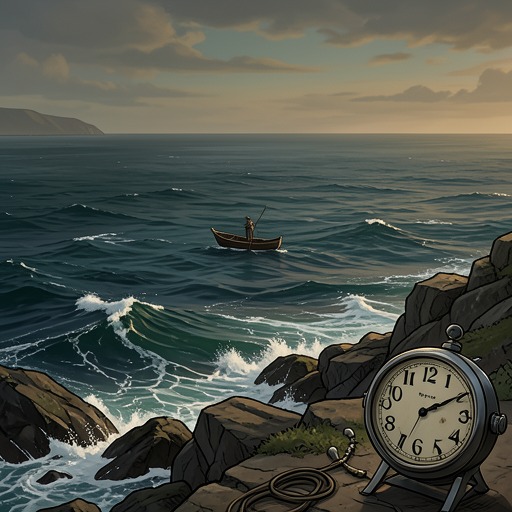
Things are just things. Stories are just stories.
All the Light We Cannot See“Things are just things. Stories are just stories.” appears as a spare assertion amid Marie-Laure’s fear that the Sea of Flames may be responsible for the sorrows surrounding her. Its significance lies in the tension between the plainness of the sentence and the uncertain power she still grants the stone: she can name the curse a story, yet cannot simply dismiss what her father and the people she has lost seem to make possible.
Form and Immediate Context
The line follows Marie-Laure’s repeated handling of the stone. Its hundreds of facets catch the light; she picks it up, then immediately sets it down again, as though it burns her fingers. The gesture gives the saying its immediate force. Against an object whose appearance invites stories of wealth, danger, and desire, the sentence insists on a distinction between a thing and the meaning attached to it.
That distinction is tested by what Marie-Laure remembers. Her father has been arrested, Harold Bazin has disappeared, and Madame Manec has died. She wonders whether one rock could have caused so much sorrow. The question does not establish that the stone caused these events; it shows why the legend has become difficult for her to treat as an abstract tale.
The Legend and Its Counterclaim
The story attached to the Sea of Flames promises that its keeper will live forever, while misfortune will fall, one after another, on everyone the keeper loves. Marie-Laure has also heard Dr. Geffard describe the stone as an object queens might have worn and wars might have been fought over. Its history and supposed curse give it a reach far beyond its physical form, turning possession into a possible threat to loved ones.
“Things are just things. Stories are just stories.” offers a compact refusal to let that legend become unquestioned fact. Yet it is not a settled verdict. Marie-Laure immediately considers throwing the stone into the street or the sea, or giving it away. Those imagined actions show that the story has practical consequences even as the sentence tries to limit its authority: if the stone were only an ordinary object, there would be no need to rid herself of it to protect anyone.
A Doubt That Remains
The scene keeps the saying in tension with Marie-Laure’s next choices. While Etienne climbs to the attic and turns on the transmitter, she puts the stone in her pocket and picks up the model house. Before reaching the wardrobe, she stops to consider what her father’s elaborate puzzle box and decision to leave the stone behind in Saint-Malo might mean. She reasons that he must have believed the danger was real, perhaps fearing the stone would be confiscated on his journey back.
She then considers the difference between the object and its appearance: it must at least look like a blue diamond worth twenty million francs, convincing enough to persuade her father. She also wonders how her uncle will respond if she tells him they should throw it into the ocean. The expression therefore marks neither proof of the curse nor freedom from it. It names a skeptical possibility, while the scene’s unresolved questions show how stories can continue to govern decisions even when their truth remains uncertain.